
Following Prisoner 14,200: Finding John Laddison in the Archives
A conversation with Dr. Rhondda Robinson Thomas reveals new details about John Laddison’s imprisonment, forced labor, release, and final months in Anderson County.

For years, much of what we knew about John Laddison came from newspaper accounts describing the final days of his life and the racial terror lynching that took place in Anderson County in 1901.
Those accounts told us what others accused him of doing. They told us how a mob pursued him. They told us how he died.
But they told us very little about who he was.
That began to change when Dr. Rhondda Robinson Thomas, a professor at Clemson University and one of the most thoughtful researchers I know, offered to visit the South Carolina Department of Archives and History on our behalf. Dr. Thomas has spent years uncovering the stories of incarcerated men, including teenage boys, whose labor helped build Clemson College. Her research into South Carolina’s convict labor system gave her a unique understanding of where to look and how to follow a person through records that were never created to preserve his story.
When we sat down together, she opened her computer and began walking me through what she had found.
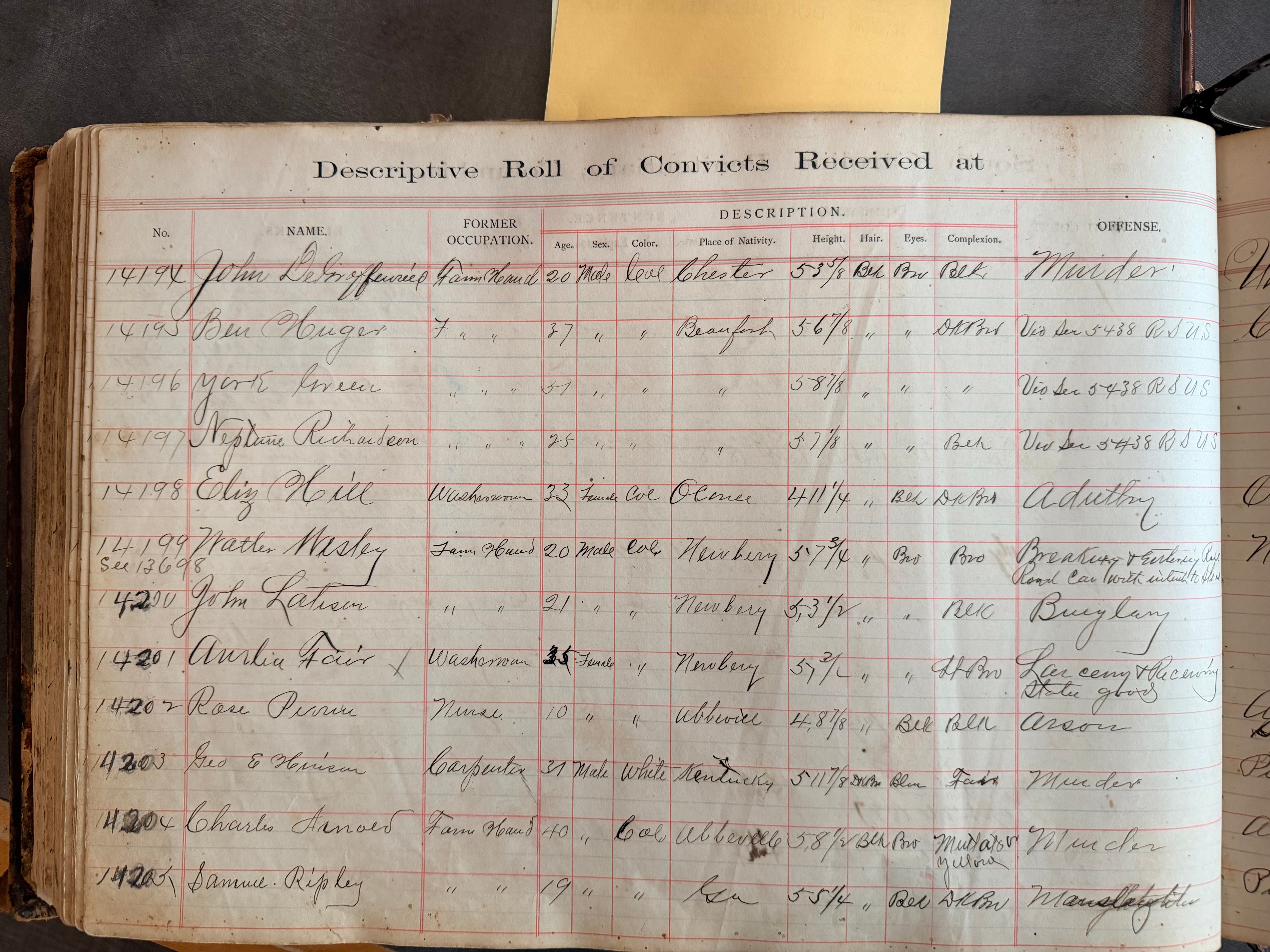
The first breakthrough was a name: John Lattison.
Then another spelling appeared: John Latson.
Then another: John Latison.
The spelling kept changing, but one number remained the same: prisoner number 14,200.
As Dr. Thomas told me, once you have the prisoner number, “the whole world opens up.”
That number connected John across multiple penitentiary records. For the first time, we could begin to see him not merely as the subject of a lynching account, but as a young man from Newberry County. He was 21 years old, stood just 5 feet, 3½ inches tall, worked as a farm hand, and had been convicted of burglary as a first-time offender. He was sentenced to five years and eventually assigned to a convict labor operation associated with the Cooley farm or plantation near the Savannah River.
The records also revealed something that may reshape how we understand the final months of his life: John was discharged from the convict labor camp on February 18, 1901, several months before he was lynched.
He had completed his time, yet he remained in the area.
Why?
Did he have transportation home to Newberry County? Did he know the sharecroppers working near the farm? Was he searching for food, employment, or a place to stay? Had the relationships created during his imprisonment become the only community available to him after his release?
We do not yet know the answers. But we finally have new questions grounded in archival evidence.
What follows is my effort to document what Dr. Thomas discovered, what it teaches us about South Carolina’s convict labor system, and where this research may lead next. This is not the conclusion of John Laddison’s story. It is the opening of another door.
And for the first time, we may have found the archival trail that allows us to follow him through it.
Dr Thomas Meeting & Conversation
July 21, 2026 / 9:30am
This conversation is a major breakthrough for the John Laddison research. Dr. Rhondda Thomas did more than find another record—she uncovered the archival key that can help you reconstruct his life before the lynching.
What Dr. Thomas found
The most important discovery is John Laddison’s prisoner number: 14,200.
His name appears with at least three spellings:
John Lattison
John Latson
John Latison
The prisoner number proves these records describe the same person. That number now gives you a reliable way to follow him across different books, even when clerks changed the spelling of his name.
The records indicate that Laddison:
Was approximately 21 years old
Was from Newberry County
Worked as a farm hand
Was about 5 feet, 3½ inches tall
Had black hair, brown eyes, and a dark complexion
Had a physical mark or condition noted on the right side of his neck
Was convicted of burglary
Was identified as a first-time offender
Was sentenced to approximately five years
Was assigned to the Cooley farm or plantation convict-labor detail
Was discharged early on February 18, 1901
Was the only prisoner shown as released from that location on that particular day
That last point feels especially important. He was apparently released alone, without an obvious group being transported back toward Columbia or Newberry.
How this changes the known story
Until now, John Laddison could easily be described mainly through the events surrounding his lynching. These documents begin to recover him as an individual.
He was not simply an unidentified laborer wandering near a farm. He was a very young man from Newberry County who had spent years inside South Carolina’s penitentiary and convict-leasing system. He had been released only months before his death but remained near the property where he had labored.
That raises a much more human set of questions:
Did he remain because he had nowhere else to go?
Was transportation home provided after his release?
Had he developed relationships with sharecroppers or other laborers?
Was he trying to find paid work or food?
Did he continue working informally on the property after his sentence ended?
Was the sharecropper’s home where he reportedly sought food occupied by someone he already knew?
Did the structures and relationships of the convict camp leave him vulnerable even after he was legally free?
The lynching story may therefore involve not only racial terror, but also the aftermath of convict leasing: a man technically released from prison but still trapped geographically, economically, and socially within the world of the labor camp.
The convict-labor connection
Dr. Thomas provided a strong framework for understanding how the Cooley operation may have worked.
The state penitentiary could place prisoners with farms, plantations, colleges, construction projects, or other contractors. The receiving organization or property owner would likely have been responsible for matters such as:
Housing or a stockade
Armed guards
Food and prison clothing
Medical treatment
Transportation
Work assignments
Payments or contractual obligations to the state
The prisoners could be chained, confined, and worked under strict supervision. Dr. Thomas described regulations allowing them to be unchained on Sundays for Sabbath observance—an extraordinary detail that gives a glimpse into daily conditions.
This places John Laddison within a system that transferred incarcerated labor into private or institutional development. It was cheaper than employing a free construction crew or farm workforce, and it carried forward many of the economic and social structures of slavery.
The archival roadmap she gave you
Dr. Thomas essentially handed you the next phase of the investigation.
1. Follow prisoner number 14,200 through the security-check books
The security records may reveal:
When Laddison arrived at Cooley
Whether he was previously assigned elsewhere
Whether he moved repeatedly between the penitentiary and labor sites
Which other prisoners traveled or worked with him
Who was present at Cooley around the time of his discharge
The best method would be to begin around February 18, 1901, and work backward toward the date of his conviction.
2. Examine the Newberry County indictment records
Dr. Thomas located Newberry County indictment material covering approximately 1899–1908 in the South Carolina archives.
These records may include:
The formal indictment
Arrest warrants
Affidavits
Witness testimony
The location of the alleged burglary
Names of relatives, neighbors, employers, or co-defendants
Information about where Laddison lived
The circumstances of his arrest and trial
Possible statements in his own words
This could be the richest source for restoring his voice and family context.
3. Search penitentiary superintendent correspondence
The superintendent’s papers may contain communications involving Cooley Farm or its owner or operator.
Possible discoveries include:
The formal labor contract
Requests for prisoners
Payment receipts
Number of prisoners assigned
Complaints or disciplinary reports
Information about housing and guards
Transportation arrangements
Correspondence about Laddison’s release
4. Identify the Cooley property and its ownership
You will need to determine:
Whether “Cooley” was a person, farm, plantation, or contracting entity
The property boundaries around 1898–1901
Its relationship to the Savannah River
Whether portions of it were later submerged
Its proximity to the cotton gin, crossroads, sharecropper property, and suspected lynching site
Historical plats, tax records, deeds, agricultural census records, railroad maps, and Hartwell reservoir acquisition records could all be useful.
5. Identify the sharecroppers
Dr. Thomas introduced an especially promising possibility: the convicts may have worked alongside sharecroppers.
Finding the names of sharecroppers or tenant farmers could help explain:
Why Laddison remained nearby
Whose home he approached for food
Whether he knew the family
Whether former prisoners transitioned into farm labor after discharge
Whether oral traditions survived among local families
This may be where Josh Johnson’s expertise becomes invaluable. Dr. Thomas’s recommendation of him was emphatic—particularly for maps, land ownership, Upstate families, and archival fragments that are difficult to locate.
A possible new interpretation
The historical narrative may eventually be framed something like this:
In February 1901, twenty-one-year-old John Laddison was released from a South Carolina convict-labor camp operating at or near the Cooley plantation. Although his sentence had ended, the records raise questions about whether he had the transportation, money, family support, or opportunity necessary to return to Newberry County. Months later, he remained in the area where he had been forced to labor. When he reportedly approached a nearby home seeking food, his presence was interpreted through the racialized assumptions attached to a young Black former prisoner. Those conditions may have helped set in motion the accusations, pursuit, and racial terror that ended his life.
That interpretation is not yet proven, but it is now a researchable hypothesis grounded in records, rather than speculation floating without an archival foundation.
The deeper theme of the conversation
Dr. Thomas also articulated something central to the entire Finding Reuben project: historical recovery does not happen through one miraculous document. It happens through accumulated fragments.
A misspelled surname.
A prisoner number.
A discharge entry.
A farm contract.
A name in an indictment.
A family recollection.
A map.
A forgotten property tradition.
Each piece makes the person more visible.
Her strongest lesson may be this: do not let the archive’s fragmentation become a second disappearance. The fact that John Laddison’s story is scattered across counties, institutions, spellings, and record systems is itself part of the history.
And her point about presentation fits your work perfectly: the research should not merely be accurate. It should be presented with beauty, care, and dignity because the manner in which these stories are preserved is itself a form of memorialization.
The next major research goal is clear: reconstruct John Laddison’s journey from Newberry County, through prisoner number 14,200, into the Cooley convict-labor camp, through his solitary release on February 18, 1901, and into the final months of his life in Anderson County.
Thomas, Rhondda Robinson. Personal interview. 21 July 2026, 9:30 a.m., Sirrine Hall, office 220C, Clemson University.